Rental Property Maintenance Management Uganda: A Landlord's Complete Guide
RentEase Team
20 April 2026
Ask any Ugandan landlord what keeps them up at night and most will say the same things: late rent, difficult tenants, and maintenance.
Of the three, maintenance is the one that most landlords feel the least control over. Rent collection can be systematised. Tenant selection can be improved with better screening. Maintenance is the awkward one. The timing is unpredictable, the costs vary, and every job needs coordination between tenants, caretakers and contractors, so the whole thing can feel chaotic.
It does not have to be. Most of what follows is a matter of writing the same things down in the same place every time.
Why Maintenance Management Matters More Than Most Landlords Realise
Property upkeep is necessary to retain a property's value, but it can also be costly. Maintenance costs are one of the biggest challenges property managers face. But the cost of poor maintenance management goes well beyond the repair bills.
Tenant retention. A maintenance issue that is handled quickly and professionally reinforces a tenant's confidence that they are renting from a serious landlord. A maintenance issue that is ignored, denied, or handled chaotically does the opposite, and often ends a tenancy that might otherwise have continued for years. With vacancy rates averaging 9% in premium Kampala locations, the cost of losing a good tenant far exceeds the cost of handling maintenance competently once you add up lost rent during the vacancy, re-letting costs, cleaning and downtime.
Asset value. Uganda's Residential Property Price Index put annual residential property inflation at 6.4% for the year ended Q4 FY2025/26, down from 10.5% a quarter earlier. Maintaining that appreciation requires maintaining the physical condition of the asset. Deferred maintenance compounds. A small problem ignored becomes a large problem, then a structural issue, then an insurance claim or a major capital expenditure.
Legal exposure. Landlords in Uganda are required to maintain the property in a habitable condition, including repairs to plumbing, electricals, and the roof, and there must be a clear process for reporting maintenance issues with a reasonable timeline for repairs to be addressed. A formal maintenance system gives you documented evidence that you fulfilled this obligation. An informal WhatsApp thread gives you nothing.
Part 1: The Lifecycle of a Maintenance Request, Done Right
Here is what a properly managed maintenance request looks like, from the moment a tenant notices a problem to the moment it is resolved.
Step 1: The Tenant Reports the Issue
The tenant notices a problem, say a leaking tap or a broken lock, and submits a request through the platform. They describe the issue, attach one or two photos showing the problem clearly, and select the property and unit.
This happens from their phone, at any time of day or night, in under two minutes.
The submission is timestamped automatically. The landlord is notified immediately. A record is created in the system.
Why this matters: The tenant does not need to wonder whether you received their message. You do not need to find a photo buried in a WhatsApp thread from three days ago. The record exists from the first moment, attached to the correct property, with a timestamp that neither party can dispute.
Step 2: The Landlord Reviews and Assigns
You see the request on your dashboard, review the photo and description, and assess priority. For an urgent issue such as a burst pipe or an electrical fault that creates a safety risk, you mark it urgent and assign it to your plumber or electrician. For routine issues, you assign it on a standard timeline.
The assignment is logged. The assigned contractor receives a notification by SMS and email. That notification is triggered by the assignment itself, so it fires regardless of which screen made it, and the contractor never needs a login. The tenant was already notified that the request was received.
Why this matters: The tenant stops wondering whether anything is happening. You have a documented record of when you acknowledged the request and what action you took. The contractor has a formal brief, not a forwarded WhatsApp message.
Step 3: The Work Is Completed
The contractor completes the repair. They confirm completion through the platform or directly with you. You log the completion and the cost: contractor fee, materials, any ancillary expenses.
The tenant receives an automatic notification: the issue has been resolved.
Why this matters: The cost is logged against the specific property and unit, automatically. No manual entry into a spreadsheet. No receipt photographed and saved to a folder. Date, description, cost and contractor stay attached to the maintenance record permanently.
Step 4: The Audit Trail Is Complete
From report to resolution, the entire lifecycle of the request is documented in one place: what was reported, when, by whom, what it looked like, who was assigned, when the work was completed, what it cost, and when the tenant was notified.
This audit trail is available to you, to your accountant, and to a court if it ever comes to that.
Part 2: Reactive vs. Preventive Maintenance, and Using Data to Save Money
Most landlords manage maintenance reactively. Something breaks. They fix it. They pay the bill. They move on.
This is the most expensive way to maintain a property.
Preventive maintenance means finding and fixing problems before they become failures, and it is almost always cheaper. But it requires data. Specifically, it requires visibility into your maintenance history that most informally managed landlords simply do not have.
Here is a concrete example from the Ugandan rental context.
Imagine a water pump in one of your units has been repaired three times in fourteen months. Each time, a plumber came, fixed the immediate fault, and left. Each call-out cost UGX 80,000–120,000 in labour plus parts. Total spend over fourteen months: approximately UGX 380,000.
If you are managing maintenance through WhatsApp messages and handwritten notes, those three repairs look like three separate events. There is no visible pattern.
If you are managing maintenance through a digital platform, those three repairs are attached to the same unit and the same piece of equipment, in a searchable maintenance history. The pattern is visible immediately: this pump has failed three times. The cost of replacement is UGX 650,000. You have already spent 58% of that on repairs in fourteen months. Replacement is the rational decision, and the data is the only thing that tells you so.
A well-maintained property data set reveals patterns like:
- Which units generate the most maintenance requests (and might need capital investment)
- Which contractors complete work fastest and at lowest total cost
- Which systems (plumbing, electrical, HVAC) are approaching the end of their reliable lifespan
- Which issues are seasonal (roof leaks after heavy rains, pump failures in dry periods)
None of it is visible without systematic record keeping.
Part 3: What Good Maintenance Communication Looks Like
Maintenance is one of the highest-stakes touchpoints in the landlord-tenant relationship. How you handle it communicates far more than the repair itself.
A tenant who submits a maintenance request and hears nothing for five days has lost confidence, whether or not the issue is eventually fixed. They feel ignored. They begin to wonder whether their next request will also disappear. When their lease comes up for renewal, that accumulated frustration tips the balance toward moving out.
A tenant who submits a request, receives an immediate confirmation, gets an update when a contractor is assigned, and receives a resolution notification when the work is done feels professionally managed. They may not consciously think about it, but the subconscious ledger of their rental experience is strongly positive.
The communication framework for every maintenance request:
- Acknowledgement within 24 hours (automatic through a digital platform)
- Assignment confirmation with an estimated timeline for the tenant
- Progress update if the repair takes longer than expected
- Resolution confirmation when the work is complete
- Follow-up check (a brief message asking whether the issue has been fully resolved)
On a platform that automates steps one, three and four, the framework costs you almost nothing to run.
Part 4: The Financial Side of Maintenance
Be precise about what tracking maintenance does and does not do for your tax bill, because this is widely got wrong in Ugandan landlord advice.
If you hold property as an individual, maintenance is not deductible against rental income. URA's method is to take your gross rent from all sources, subtract the threshold of UGX 2,820,000, and charge 12 percent on the rest. In URA's own words, no other deductions are allowed: not repairs, not the caretaker, not mortgage interest. Tracking your maintenance costs will not reduce that number by one shilling.
If you hold property through a company, the position is different: URA allows a deduction of up to 50 percent of gross rental income for expenditures and losses, with tax charged at 30 percent on what remains, and it verifies claimed expenses. There, records are the difference between a deduction you can substantiate and one you cannot.
So for most individual landlords, the point of tracking maintenance is not the tax return. It is the return on the asset. A property that looks like it yields 7% gross but incurs UGX 2.4 million a year in maintenance is not a 7% yield investment. You pay 12 percent tax on the gross rent either way, which makes knowing your real net figure matter more, not less. Our guide to tracking rental income and expenses in Uganda works the whole calculation through.
Building Your Maintenance System Today
The infrastructure for professional maintenance management in Uganda does not require a property management company, a dedicated maintenance coordinator, or a large budget.
It requires a platform that:
- Gives tenants a formal channel to submit requests with photos
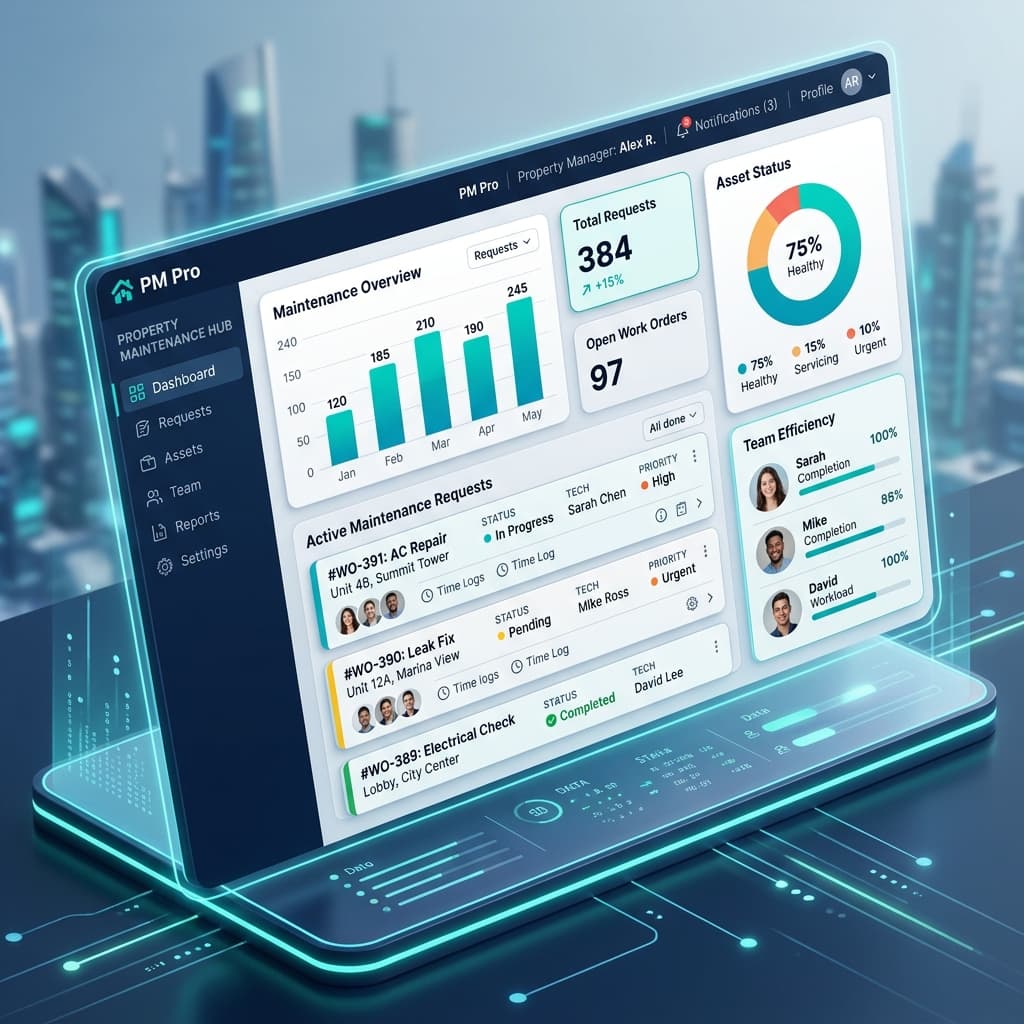
- Gives landlords a dashboard to review, assign, and track every request
- Logs costs automatically against the correct property
- Creates a permanent, searchable maintenance history
- Sends automatic notifications to keep all parties informed
RentEase includes all of this as a core feature rather than a paid add-on, because for a Ugandan landlord maintenance is never a side concern.
Start managing maintenance professionally
No payment details required.
Sources
- Uganda Bureau of Statistics, Residential Property Price Index, Q4 FY2025/26
- Uganda Revenue Authority, A Simplified Guide on Rental Income, for the individual 12 percent rate with no deductions and the company 50 percent allowance at 30 percent (PDF)
- The Africanvestor, Kampala real estate market analysis, for prime vacancy running near 9 percent